July 18, 2026
Why Products Containing Batteries, Liquids, or Magnets Face International Shipping Restrictions and What Alternatives Are Available
Why International Shipping Rules Treat Batteries, Liquids, and Magnets Differently
A product containing a battery, liquid, or magnet is not automatically prohibited from international shipping. The real question is whether the completed shipment can satisfy the rules for the selected transport mode, carrier, origin country, and destination.
Before paying for shipping, identify exactly what the product contains. For batteries, determine the chemistry, capacity and configuration. For liquids, check the ingredients and hazardous properties rather than considering only the volume. For magnetic products, assess the external magnetic field after the item has been fully packed.
This classification step usually determines whether you can use ordinary parcel shipping, need an approved dangerous-goods service, must change the route, or should remove or replace the restricted component.
Identify What Is Actually Causing the Restriction
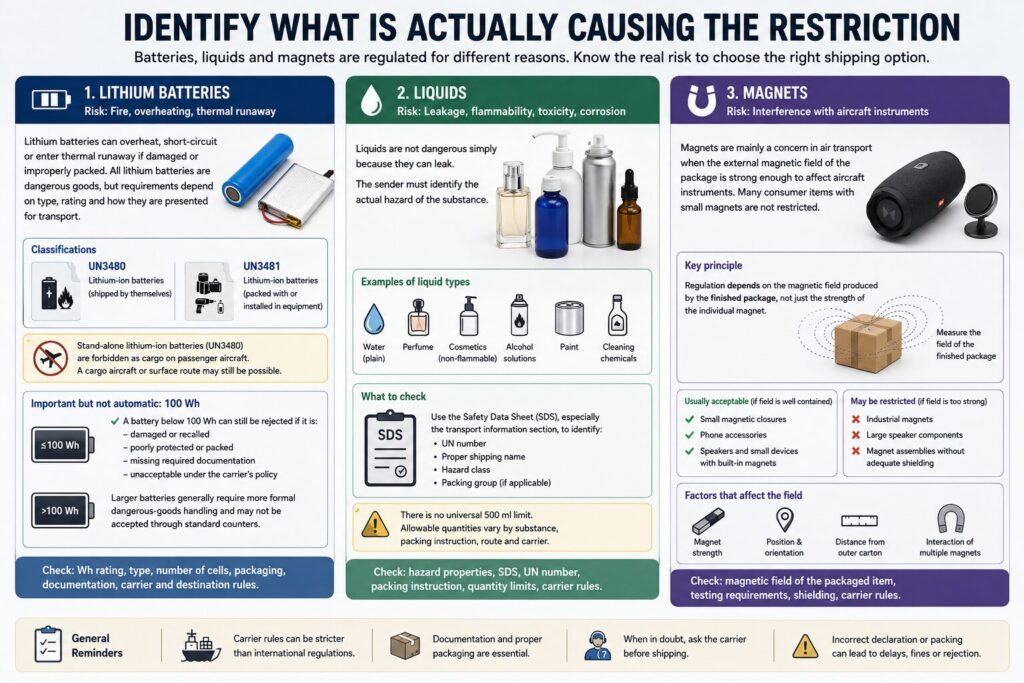
Products with batteries, liquids and magnets are handled differently because they create different transport risks. They should not be grouped together under one general rule.
Lithium batteries can overheat, short-circuit or enter thermal runaway if they are damaged or improperly packed. All lithium batteries are treated as dangerous goods for transport, although smaller batteries installed in ordinary consumer devices may qualify for less demanding packing and documentation provisions. The requirements depend on the battery chemistry, Watt-hour rating, number of cells or batteries and how they are presented for transport.
A lithium-ion battery shipped by itself is normally classified as UN3480. A lithium-ion battery packed with equipment or installed inside it is generally classified as UN3481. This distinction matters because stand-alone lithium-ion batteries are subject to stricter air transport conditions and are forbidden as cargo on passenger aircraft. A compliant cargo-aircraft or surface route may still be possible, depending on the carrier and destination.
The frequently mentioned 100 Wh threshold is important, but it should not be treated as an automatic approval limit. A battery below 100 Wh can still be rejected if it is damaged, recalled, poorly protected, missing required documentation or unacceptable under the carrier’s own policy. Larger batteries generally require more formal dangerous-goods handling and may not be accepted through standard consumer shipping counters.
Liquids require a different assessment. A liquid is not dangerous merely because it may leak. Plain water, non-flammable cosmetics, perfume, alcohol solutions, aerosols, paint and corrosive cleaning chemicals do not share the same classification.
The sender needs to identify whether the product is flammable, corrosive, toxic, pressurized or otherwise regulated. The Safety Data Sheet, particularly its transport information, can help determine whether the substance has a UN number, proper shipping name, hazard class or packing group. A fixed volume such as 500 ml should not be presented as a universal international limit because allowable quantities vary by substance, packing instruction, route and carrier.
Magnets are mainly an air-transport concern when the external magnetic field of the packaged shipment is strong enough to affect aircraft instruments. A product may contain magnets without becoming regulated magnetized material. Small closures, phone accessories and speakers may be accepted when their field is sufficiently contained, while industrial magnets and some large speaker components may require testing, shielding or a different route.
The relevant measurement is the field produced by the finished package, not only the strength claimed for an individual magnet. Position, orientation, distance from the outer carton and interaction between multiple magnets can change the result.
Choose the Alternative That Matches the Product
The best alternative is usually not to remove every restricted component. It is to select the least disruptive option that produces a compliant shipment.
| Product situation | Most practical first option | Alternative when standard air shipping is unavailable |
|---|---|---|
| Small battery installed in a consumer device | Protect the device from accidental activation and confirm the carrier accepts the battery configuration | Use an approved battery service or surface route |
| Loose lithium-ion battery or power bank | Ask for a service that explicitly accepts UN3480 | Cargo aircraft, road, rail or sea service through a qualified operator |
| Large battery, e-bike battery or industrial pack | Use a dangerous-goods forwarder and obtain battery specifications and test documentation | Regional assembly, local battery sourcing or surface freight |
| Non-hazardous liquid | Use secure closures, secondary containment and suitable outer packaging | Domestic fulfillment closer to the customer |
| Flammable, corrosive or otherwise regulated liquid | Classify it using the SDS and use an approved dangerous-goods service | Reformulate, reduce concentration, use surface freight or manufacture regionally |
| Product with a small magnet | Test or confirm the field of the finished package | Reposition, pair, shield or increase the distance from the outer carton |
| Product with a strong industrial magnet | Obtain specialist magnetic-field testing and carrier approval | Surface transport, local sourcing or redesigned assembly |
For battery products, shipping the device with the battery properly installed may be easier than sending a loose spare battery, but the product must be designed and packed to prevent short circuits, movement and unintended operation. Damaged, swollen, defective or recalled lithium batteries should not be placed into an ordinary parcel network.
Removing a battery can be useful only when it is technically and commercially realistic. Sending the removed battery in a second parcel does not remove its dangerous-goods classification. In some cases, the easier solution is to ship the device without a battery and instruct the customer to purchase an approved battery locally.
For liquids, changing the formulation can reduce logistics difficulty, but the replacement must be evaluated rather than assumed to be unrestricted. A solid perfume, powder or cleaning tablet may simplify shipping, whereas an aerosol or alcohol-based concentrate may remain regulated.
Businesses with regular international orders should also consider regional fulfillment. Shipping larger compliant commercial consignments to a trained warehouse and completing the final delivery domestically can be more predictable than sending individual restricted parcels across borders. However, the inbound bulk shipment must still comply with the applicable air, road or sea rules.
Magnetic shielding and product redesign should be approached carefully. Packaging material, magnet orientation and spacing may reduce the external field, but specialist shielding materials can add cost and weight. Pairing magnets with opposing poles or positioning them near the center of a larger package may help, but the final configuration should be measured rather than accepted on assumption.
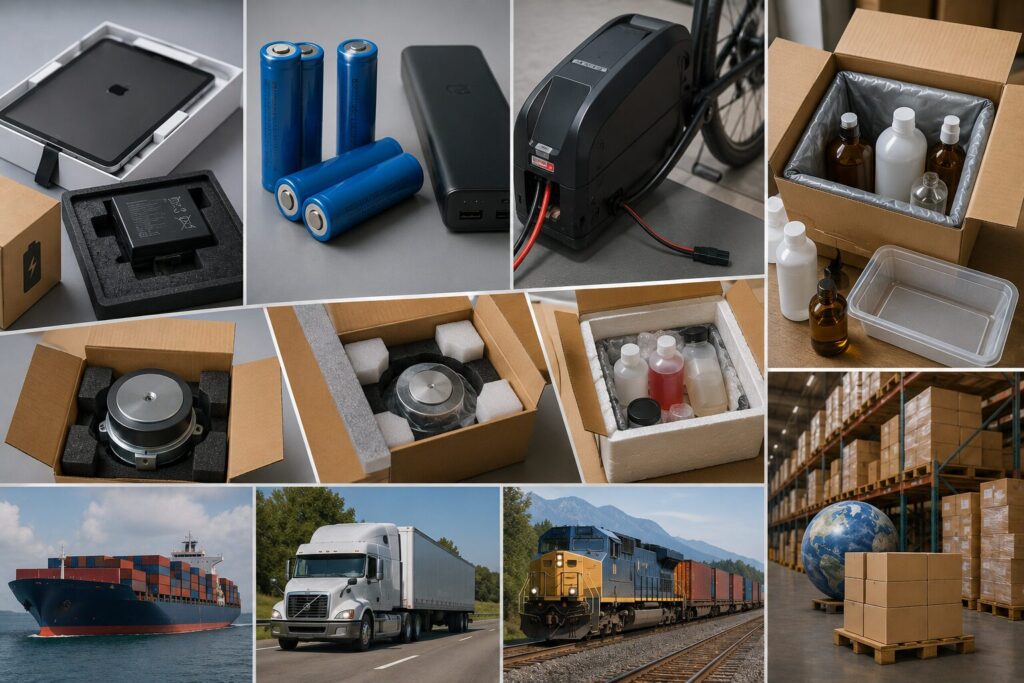
Surface transport is another alternative, but it does not eliminate regulation. Dangerous goods transported by sea are governed by the IMDG Code, while road and rail shipments may be subject to regional systems. Surface freight may allow products that cannot travel on passenger aircraft, but it can require formal classification, approved packaging, documentation and segregation from incompatible cargo.
Verify the Complete Route Before Sending the Package
A carrier’s general website is only the starting point. Acceptance can differ between countries, service levels, account types and local stations. A product accepted on one route may be refused on another even when it has the same packaging.
Before creating a label, collect the product information that the carrier or forwarder is likely to request.
For a battery product, this normally includes the battery chemistry, Watt-hour rating, number of cells or batteries, whether the battery is installed or loose, the applicable UN classification and access to the UN 38.3 test summary. For a liquid, obtain the full product name, ingredients or Safety Data Sheet, flash point where relevant, container volume and total quantity. For magnets, provide the product type, magnet specifications, package dimensions, arrangement and any completed field test.
Next, verify four separate layers:
Transport classification: Determine whether the item is unregulated, excepted, limited quantity or fully regulated dangerous goods.
Carrier acceptance: Confirm that the chosen carrier and exact service accept the classification from the origin to the destination. Some dangerous-goods services are available only to approved account holders or trained shippers.
Destination restrictions: Check whether customs, product-safety, postal, environmental or import rules restrict the item independently of transport regulations. A package can be safe to carry but still prohibited from import.
Final packaging and documents: Confirm the required inner packaging, secondary containment, rigid outer packaging, cushioning, marks, labels and declarations. Do not attach a dangerous-goods label merely because a product appears risky; incorrect labels can also cause rejection.
Do not rely on a previous successful shipment as proof of compliance. The earlier parcel may have used a different airline, transfer airport, local subcontractor or inspection process. Regulations and carrier policies can also change.
When a product cannot be accepted through standard parcel shipping, compare the total cost of four realistic outcomes: an approved dangerous-goods service, surface freight, regional fulfillment, or redesigning the product so the restricted component is sourced locally. The correct choice is the one that remains compliant across the entire route, not simply the option that produces the cheapest shipping label.