July 16, 2026
Criteria for Calculating Whether a Title Discount Event Is Actually Cheaper Than Paying Per Episode
Understanding the Real Cost of Title Discount Events
A title discount is worth using only when its final price is lower than the cost of buying the episodes you genuinely intend to watch. The percentage shown in the promotion is less important than this comparison.
Start by listing the episodes you want, checking their current individual prices and comparing their combined cost with the final bundle price. Do not base the decision on the total number of episodes included unless you are confident that you want all of them.
A discounted ten-episode bundle may be a good price for the complete season but a poor purchase for someone interested in only three episodes. The correct choice therefore depends on your viewing plan, not on the size of the advertised discount.

Calculate the Cost Based on the Episodes You Actually Want
When all episodes have the same price, calculate the individual-purchase cost with this formula:
Individual cost = Episode price × Number of episodes you plan to buy
Then compare the result with the bundle price.
Suppose individual episodes cost $2.99 and a discounted season bundle costs $14.99. Five episodes would cost $14.95 separately, so the bundle would still be four cents more expensive. Six episodes would cost $17.94, making the bundle the cheaper choice.
The minimum number of episodes required for the bundle to become cheaper can be calculated as follows:
Minimum episodes = floor(Bundle price ÷ Episode price) + 1
This formula matters because simply rounding the result up can be misleading when the two options reach exactly the same price. For example, if a bundle costs $15 and each episode costs $3, five episodes also cost $15. The bundle does not produce a monetary saving until you want a sixth episode.
The break-even result should guide the decision:
| Your planned purchase | Better starting option |
|---|---|
| Fewer episodes than the break-even number | Buy individual episodes |
| Exactly equal in total price | Compare flexibility and included benefits |
| More episodes than the break-even number | Consider the bundle |
| Every episode in the season | Compare the full individual total with the bundle |
When episodes have different prices, do not use the price of one episode as a shortcut. New releases, extended episodes or special editions may be priced differently. Add the current prices of the exact episodes you want and compare that total with the bundle.
For example, if the episodes you want cost $1.99, $2.99, $2.99 and $3.99, their combined price is $11.96. A $14.99 bundle is not cheaper for that purchase, even if its average advertised price per episode appears low.
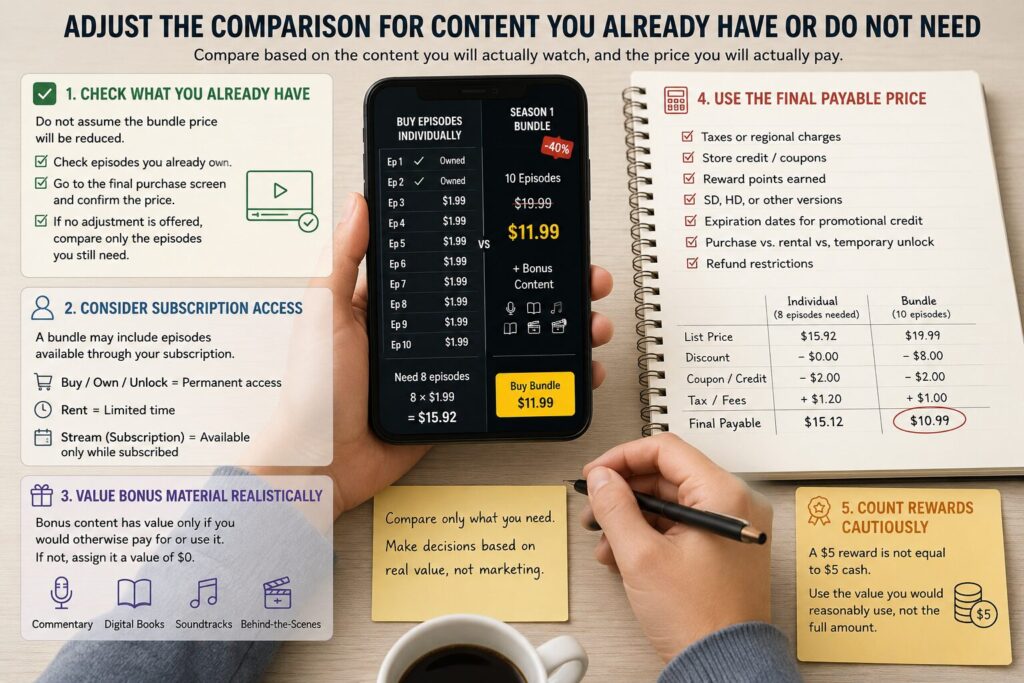
Adjust the Comparison for Content You Already Have or Do Not Need
The basic calculation is only reliable when the two purchase options provide the same useful content. Before choosing the bundle, remove any value that exists only in the advertisement but not in your actual viewing plan.
First, check for episodes you already own. Do not assume the platform will automatically subtract their value from the bundle. Open the final purchase screen and confirm whether the displayed price has been adjusted. When no adjustment is offered, compare the bundle only with the cost of the remaining episodes you still need.
Subscription access creates a similar issue. A bundle may include episodes that are currently available through your streaming membership. Buying them could still make sense when you want continued access after leaving the subscription, but temporary subscription access should not be treated as equivalent to permanent purchase. Check what “buy,” “own,” “rent” or “unlock” means on the platform.
Next, consider bonus material. Commentary, digital books, soundtracks and behind-the-scenes videos have value only when you would otherwise pay for or use them. Assign them a value of zero when they do not influence your decision. Do not let a large list of extras make an otherwise expensive bundle appear economical.
The comparison should also use the final payable price rather than the promotional headline. Review:
- Taxes or regional charges added at checkout
- Store credit or coupons that apply to only one option
- Reward points earned through the purchase
- Differences between SD, HD or other versions
- Expiration dates for promotional credit
- Whether the bundle is a purchase, rental or temporary unlock
- Refund restrictions after viewing or downloading content
Credits and rewards should be counted cautiously. A $5 reward is not the same as saving $5 today when it expires quickly, applies only to selected titles or requires another purchase. Count only the portion you are reasonably likely to use.
A useful adjusted comparison is:
Adjusted bundle cost = Final checkout price − Value of credits or extras you will realistically use
Compare that figure with the final cost of the individual episodes, calculated under the same payment conditions.
Choose Between the Bundle, Individual Episodes and Waiting
Buy the discounted bundle when its adjusted price is lower than the individual cost and you are reasonably confident that you will watch enough included episodes. It is especially suitable when you want the full season, the break-even point is low or the bundle contains extras you would genuinely have purchased.
Choose individual episodes when you want only a small portion of the title, are uncertain whether you will continue watching or already own several included episodes. Buying separately may cost slightly more per episode, but it limits the amount committed upfront and allows you to stop if the series does not hold your interest.
When both options cost almost the same, flexibility becomes more important than the advertised discount. Individual purchases are usually safer when you are undecided because you pay only as you continue. The bundle becomes more attractive when it simplifies the purchase, provides meaningful extras or offers access rights that are clearly better.
Waiting is reasonable when the platform’s purchase conditions are unclear or the promotion creates pressure without providing enough information. Before the event ends, take a screenshot or record the following:
- Promotional bundle price
- Normal bundle price
- Prices of the episodes you want
- Included formats and extras
- Ownership or rental terms
- Final checkout total
- Refund and cancellation conditions
Do not assume another promotion will appear or that the same price will return. The purpose of waiting is not to predict a future sale. It is to avoid buying until you know how much content you want and what access the current offer actually provides.
Use this final rule at checkout:
| Result of the comparison | Action |
|---|---|
| Bundle costs clearly less for the episodes you want | Buy the bundle |
| Individual episodes cost less | Buy only those episodes |
| Prices are nearly equal and you are unsure | Buy individually or delay |
| Owned episodes are not deducted | Recalculate using only missing episodes |
| Access, refund or format terms are unclear | Do not complete the purchase yet |
| Individual episodes are unavailable | Compare the sale price with the normal bundle price |
The final decision should be based on the amount charged, the episodes you expect to use and the access you receive—not the discount percentage displayed on the event banner.